When dealing with a compact bedroom, a narrow hallway, or a cozy but cramped living room, most people immediately think of painting the walls white or buying smaller furniture to save space.
While those are great strategies, there is another invisible, highly effective tool you can use to trick the eye into seeing a much larger space: Strategic Lighting Design.
Darkness and harsh shadows make walls feel like they are closing in. By controlling where the light falls and how it reflects, you can visually push back the walls, raise the ceiling, and give any small room an airy, open feel. Here are four designer-approved lighting techniques to instantly expand your space.
1. Vertical Lighting: “Wash” the Walls to Create Width
When a light fixture only points straight down at the floor, it leaves the upper corners of the walls in shadow, making the room feel like a narrow cave. To counteract this, you need to redirect light onto the walls.
- The Technique: Wall Washing. This means placing light fixtures in a way that bathes an entire wall in an even, smooth glow.
- How to do it: Use adjustable recessed ceiling lights (gimbal lights) or track lighting directed at the longest walls of the room. When the walls are brightly illuminated, they visually recede, making the room feel significantly wider.
2. Uplighting: Raise a Low Ceiling
Low ceilings can make a small room feel claustrophobic. If you can’t structurally raise the roof, you can use light to create the illusion of height.
- The Technique: Uplighting. Instead of letting all your light rain down from above, shoot some of it upward to reflect off the ceiling.
- How to do it:
- Place a tall, slender floor lamp that directs light straight up into a dark corner.
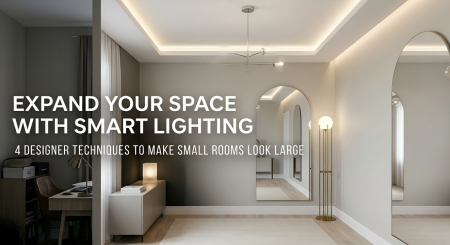
- Install LED light strips hidden behind a crown molding or on top of tall wardrobes and bookshelves. The reflected glow makes the ceiling appear higher and gives the room a modern, weightless feel.
3. Eliminate Shadows with Corner Lighting
A small room often looks tiny because its corners are pitch black, which sharply defines the exact physical boundaries of the space.
- The Technique: Perimeter Layering. By placing low-intensity light sources in the furthest corners, you blur the boundaries of the room.
- How to do it: Drop a small accent lamp on a corner side table, or place a mini-uplight on the floor behind a large indoor plant. Illuminating the corners prevents the room from feeling “boxed in.”
4. Choose Fixtures with a “Light” Visual Weight
In a small space, the physical appearance of the lamp itself matters just as much as the light it emits. A heavy, dark, solid metal dome pendant will visually crowd the center of the room.
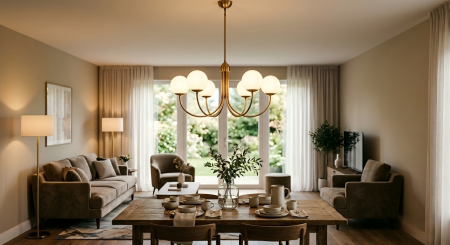
- The Rule of Thumb: Look for fixtures made of clear glass, frosted glass, open wire cages, or reflective finishes (like polished chrome or brass).
- Why it works: Glass or open-structure chandeliers allow the eye to travel straight through the fixture to the walls and windows beyond. They provide all the brightness you need without stealing any visual real estate.
Summary: The Small Space Lighting Checklist
Before you finalize your small room layout, ensure you’ve checked off these three golden rules:
- Ditch the heavy central fixture unless it is made of transparent or highly reflective materials.
- Guide the eye upward and outward by bouncing light off the ceiling and washing the walls.
- Incorporate mirrors. Placing a mirror directly opposite or adjacent to a bright light source will instantly double the illumination and create depth.
By implementing these simple optical illusions, you can stop fighting the physical limitations of your floor plan and start enjoying a home that feels bright, breezy, and beautifully spacious!

 by
by